


Testosterone Therapy and SHBG: The Hidden Connection

Updated: Sep 23
You've been told your testosterone is low. Now What?
To answer these questions, we need to look deeper - at the relationship between testosterone, SHBG, and insulin resistance, and what that interplay reveals about the connections among hypogonadism, visceral obesity, and metabolic syndrome.

How It Works on the Inside
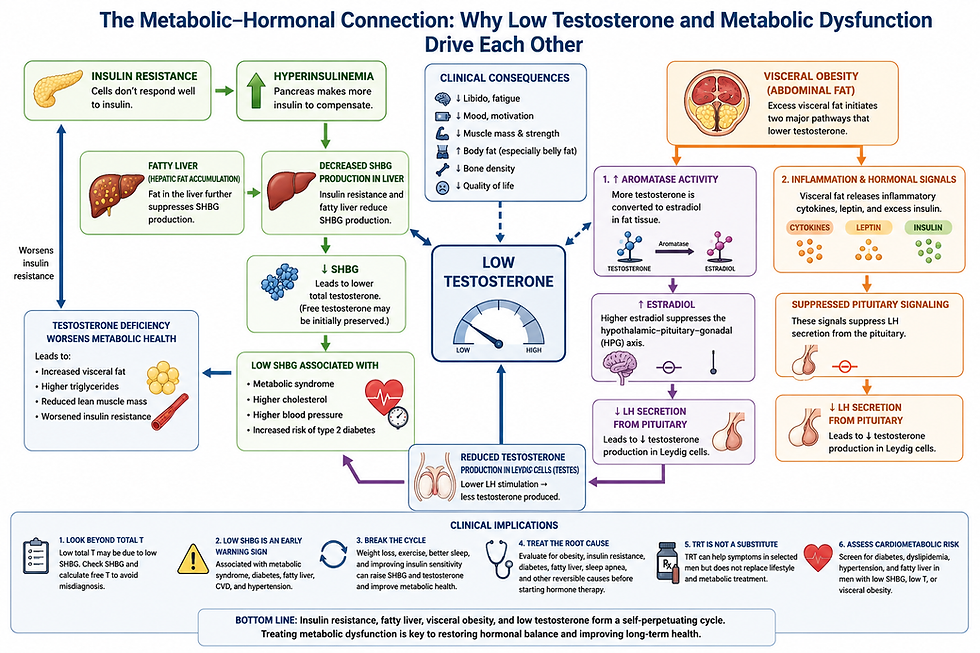
Insulin resistance - and the chronically elevated insulin levels that follow - signals the liver to reduce its production of sex hormone-binding globulin (SHBG).
When fat accumulates in the liver (fatty liver disease), SHBG production drops even further.
Lower SHBG means lower total testosterone in the bloodstream. Free testosterone may still read as normal in the early stages, but the overall hormonal environment is already shifting.
Beyond testosterone, low SHBG is independently linked to metabolic syndrome, unfavorable cholesterol levels, high blood pressure, and a greater risk of developing type 2 diabetes.
Testosterone deficiency then begins to feed the problem: it promotes the buildup of visceral (abdominal) fat, raises triglyceride levels, and erodes lean muscle mass - all of which deepen insulin resistance and close the loop.
Excess visceral fat also ramps up aromatase activity, an enzyme that converts testosterone into estradiol. As estradiol climbs, it suppresses the hypothalamic-pituitary-gonadal (HPG) axis, blunting the LH signal that tells the testes to produce testosterone in the first place.
Visceral fat does additional damage through chronic inflammation and by elevating hormones like leptin and insulin — both of which further suppress LH secretion from the pituitary, leaving the Leydig cells of the testes with little signal to work with.
In Summary
Insulin resistance, fatty liver disease, visceral obesity, and low testosterone don't simply coexist - they reinforce each other. Metabolic dysfunction drives testosterone down, and low testosterone drives metabolic health further into the ground, creating a cycle that tends to tighten over time. Breaking out of it typically requires more than good intentions: targeted lifestyle changes are essential, and for many men, medical support is part of the equation too. Ready to get some real answers? The team at Careborne Sensible Medical is here to listen, evaluate, and help you build a path forward — no pressure, no obligation. Reach out today to schedule your FREE consultation.
Why This Matters
Understanding how insulin resistance, visceral obesity, SHBG, and testosterone interact isn't just academic - it has real consequences for how men are evaluated and treated.
Metabolic dysfunction should be addressed first. Before starting hormone therapy, men with low testosterone should be evaluated for obesity, insulin resistance, diabetes, fatty liver disease, sleep apnea, and other reversible conditions. In many cases, treating the underlying cause is the more important first step. Please contact Careborne to start your journey to a healthier you!
Cardiometabolic risk should be assessed routinely. Men with low SHBG, low testosterone, or significant visceral obesity tend to carry a higher burden of cardiovascular risk factors and should be screened for diabetes, dyslipidemia, hypertension, and fatty liver disease as part of their overall care.
A low total testosterone doesn't always mean true deficiency. In men with obesity, insulin resistance, or fatty liver disease, SHBG is often suppressed - which can make total testosterone appear low while free testosterone remains essentially normal. Measuring SHBG and calculating free testosterone helps avoid treating a number rather than a condition.
Low SHBG is an early metabolic warning sign. Even when blood sugar looks normal, low SHBG signals elevated risk for metabolic syndrome, type 2 diabetes, fatty liver disease, cardiovascular disease, and hypertension. It deserves attention on its own. Talk to your Careborne provider about ordering the right labs.
Weight gain and low testosterone tend to fuel each other. Excess visceral fat suppresses testosterone production, while low testosterone encourages more fat accumulation and muscle loss - a cycle that becomes harder to reverse the longer it goes unaddressed.
TRT is not a substitute for metabolic care. Testosterone replacement therapy can relieve symptoms in the right candidate, but it doesn't fix insulin resistance, a poor diet, a sedentary lifestyle, or excess visceral fat. The best outcomes happen when hormone optimization and comprehensive metabolic management go hand in hand.
Lifestyle changes can move the needle on both fronts. Weight loss, consistent exercise, better sleep, and treatment of insulin resistance can meaningfully raise SHBG and testosterone levels - and in some men, eliminate the need for testosterone replacement altogether.
Bottom Line
In many men, low testosterone is less a standalone hormonal problem than a signal of deeper metabolic dysfunction. Looking beyond the number - evaluating SHBG, insulin resistance, visceral obesity, and liver health - gives a far more complete picture and points treatment toward the root cause, not just the lab result. Ready to find out what's actually driving your symptoms? Start with a FREE consultation at Careborne Sensible Medical.